Kenya is seeking for a new bilateral trade and investment agreement with the United States to replace earlier initiatives that ran aground, even as Washington proposes a one-year extension of the soon-to-expire African Growth and Opportunity Act (AGOA), a top Kenyan official said on Friday.
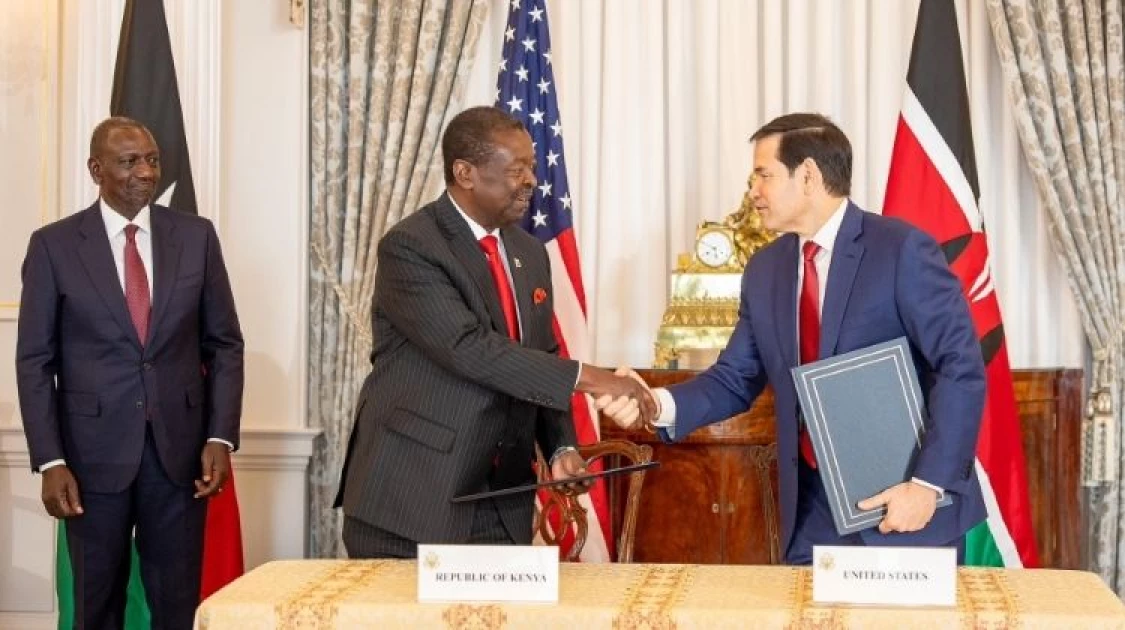
Prime Cabinet Secretary Musalia Mudavadi, who also serves as Cabinet secretary for foreign and diaspora affairs, said talks during a high-level visit to Washington this week centred on crafting a fresh reciprocal pact that would secure better market access and eventually remove tariffs hurting Kenyan exporters.
“The US wants AGOA extended for one year – that is the position of the administration,” Mudavadi told The EastAfrican. “But in the meantime, we are pursuing a bilateral agreement. The free trade agreement and the US-Kenya Strategic Trade and Investment Partnership are no longer in place.”
AGOA expires after 25 years
The African Growth and Opportunity Act, the landmark 2000 law granting duty-free access to the US market for thousands of African products, officially expired on 30 September 2025 after repeated attempts at long-term renewal stalled in Congress. For Kenya the programme has been vital, sustaining tens of thousands of jobs in textiles and agriculture and generating more than KSh60 billion (USD460 million) in exports last year alone.
President William Ruto, leading the Kenyan delegation in Washington, met United States Trade Representative Jamieson Greer to map out the next steps. Mudavadi, who accompanied Ruto, said the proposed one-year bridge would prevent an abrupt end for African exporters while both sides design “a stronger, more comprehensive programme that advances the interests of both nations”.
Earlier negotiations abandoned
Previous efforts have repeatedly faltered. During Donald Trump’s first term, the two countries explored a full free trade agreement, but negotiations never concluded. Under Joe Biden the focus shifted to the Strategic Trade and Investment Partnership, launched in July 2022 to tackle non-tariff barriers in areas such as digital trade, labour rights, agriculture and anti-corruption measures. That initiative has now been shelved.
“Even the Strategic Trade and Investment Partnership that was being negotiated is no longer in place,” Mudavadi confirmed. “They have been talking of bilateral trade agreements.”
Trump tariffs add pressure
The urgency has been sharpened by Trump’s reciprocal tariff policy. Since 9 April 2025, most Kenyan goods entering the United States have faced a 10% duty – the lowest band but still painful for exporters, according to Nairobi.
“Kenya is at the lowest band of tariffs, but we did discuss that even the 10% is hurting some of our exporters,” Mudavadi said. “The whole idea of the bilateral trade agreement is to eventually resolve this in totality.”
Kenyan officials are targeting growth in apparel and textiles, agriculture, leather and footwear, chemicals and pharmaceuticals, and information communication technology and digital services – sectors they believe can create thousands of jobs and attract new investment if barriers are lowered.
Other gains during Washington visit
The Washington trip produced other visible results. Ruto witnessed the signing of a new US-Kenya health cooperation framework alongside Secretary of State Marco Rubio, and shook hands with Trump after the US-brokered Democratic Republic of Congo-Rwanda peace accord was signed at the United States Institute of Peace on 5 December.
China factor looms large
The fate of AGOA carries implications far beyond Kenya. Bipartisan lawmakers in Washington see the programme as a strategic counterweight to China’s expanding footprint in Africa. Beijing announced in June that it would remove tariffs on goods from 53 of 54 African countries, intensifying the rivalry for influence.
Republican congressman Adrian Smith, a member of the House Ways and Means Committee that oversees AGOA, has called the law a “pillar of US diplomatic relations” and a demonstration of “America’s commitment to Africa’s young, growing population”. Democratic Senator Chris Coons, who co-sponsored a 2024 bill for a 16-year extension, warned that failure to renew the pact would allow China to fill the vacuum.
An International Trade Centre study estimates that without AGOA, exports from the 32 eligible African countries to the United States would fall 8.7% by 2029, even after accounting for recent US tariff measures. A renewed programme would limit the damage to around 8%.
For now, the one-year extension awaits congressional approval. Kenyan officials say they are working flat out to turn the temporary reprieve into a broader, more predictable partnership.
“Our discussions went further, focusing on the development of a new bilateral trade arrangement that will elevate Kenya-US economic cooperation to the next level,” Mudavadi said. “We are working on a joint framework that will open new trade opportunities, strengthen predictability for investors, and build a modern partnership that reflects the ambitions of our two countries.”
With thousands of jobs and billions of dollars in trade hanging in the balance, Nairobi and Washington have a narrow window to transform a stop-gap measure into a lasting deal.