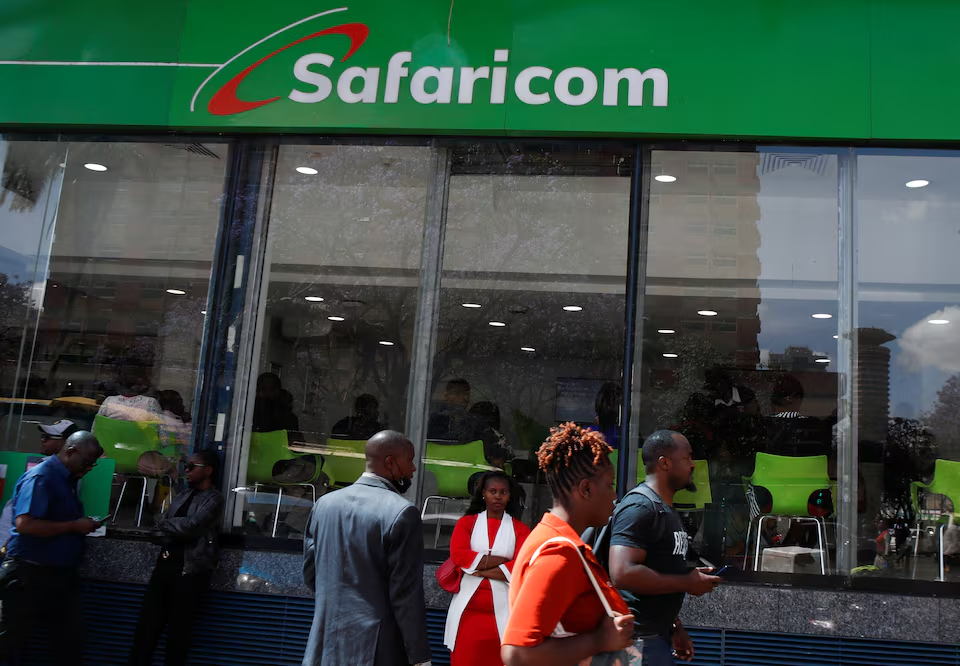
Safaricom, Kenya dominant telecoms group, on Tuesday opened subscription for the country first-ever tax-free corporate green bond, a landmark KSh15 billion (USD116 million) five-year issue that analysts say could reignite a sleepy local debt market while channelling funds into climate-friendly infrastructure.
The bond, which carries a fixed 10.4% coupon, is fully exempt from Kenya standard 15% withholding tax on interest income for portions allocated to certified green projects lasting at least three years. That pushes the effective pre-tax yield to roughly 12.35% – well above the 11.8% offered by East African Breweries in its recent corporate paper and competitive even against falling government securities yields.
“This is a game-changer for Kenya capital markets,” said Valerie Okello, equity and fixed-income analyst at Capital A Investment Bank. “You’re getting a blue-chip name with a tax-free kicker at a time when Treasury yields are sliding. Demand should be very strong.”
Bond terms and subscription
Subscription opened Tuesday 25 November and runs until 5 December, with allotment scheduled for 8 December and subsequent listing on the Nairobi Securities Exchange NSE. Safaricom has kept its options open: while the base target is KSh15 billion, a KSh5 billion greenshoe option could push the total raise to KSh20 billion if bids overshoot expectations – a scenario many in the market now consider likely.
Use of proceeds
Every shilling raised must finance projects that meet strict international green-bond principles. In Kenya, that includes expanding 4G and 5G coverage in underserved areas, installing solar panels on thousands of base stations, retrofitting buildings for energy efficiency, deploying artificial-intelligence tools to optimise power consumption, and supporting pollution-prevention and sustainable land-use initiatives.
Across the border in Ethiopia, where Safaricom holds a 53.7% stake in the newly liberalised market, proceeds will accelerate network rollout and ease cash-flow strains still lingering from last year’s sharp currency devaluation.
The company has 24 months to deploy the funds into qualifying projects; any temporary surplus can sit in interest-bearing instruments until needed.
Market timing and context
The timing is near-perfect. Kenya benchmark 10-year Treasury bond yield has tumbled almost three percentage points over the past year to 13.05% as the Central Bank reins in inflation and eases monetary policy. Against that backdrop, a tax-free corporate issue from East Africa most profitable listed company – one that powers the ubiquitous M-Pesa money-transfer platform used by more than 40 million Kenyans – looks almost too good to pass up.
Safaricom has form in sustainable finance. Only two months ago it doubled a sustainability-linked loan facility to KSh30 billion. Tuesday green bond takes that commitment further at a moment when Kenya broader corporate debt market has been almost moribund, with just KSh26 billion in outstanding corporate bonds at the end of September.
Investor interest and financial performance
Investors seem eager to pile in. “Safaricom credit is effectively bullet-proof,” Okello noted. “Add the ESG appeal and the tax advantage, and institutional investors – pension funds, insurers, banks – will fight for allocation.”
The numbers explain the confidence. In the half-year to September, Safaricom posted an 11.1% rise in revenue to KSh199.9 billion, driven by a 14% surge in M-Pesa earnings to KSh88.1 billion. Net profit jumped 52.1% to KSh42.7 billion, buoyed by a 59% reduction in Ethiopian losses to KSh15.2 billion.
Leadership perspective and outlook
For chief executive Peter Ndegwa, the bond is both pragmatic and symbolic. “We are funding the next phase of digital and financial inclusion in a way that directly reduces our environmental impact,” he said in a statement. “At the same time we are giving investors an attractive, responsible return.”
If the issue sails past its KSh15 billion target – and early soundings from fund managers suggest it will – analysts believe it could jolt other large Kenyan corporates out of their reliance on bank loans and prompt a wave of green or sustainable bond issuance across East Africa.
For now, though, all eyes are on Safaricom. Ten days remain for investors to place their bids. Given the company that turned a simple SMS into a continent-wide mobile-money revolution, persuading the market to bankroll its green ambitions looks like the easy part.