Guinea dissolves 40 political parties in push for one-party rule
Guinea government has dissolved 40 political parties, including the country’s three main opposition groups, in a move critics say marks the final step toward a one-party state under President Mamady Doumbouya. The action sent an unmistakable signal — dissent, at least in any organised political form, will no longer be tolerated.
The Ministry of Territorial Administration and Decentralisation issued the decree late on Friday, citing the parties’ failure to meet their legal obligations. The government did not specify what those obligations were, a vagueness that opposition figures and democracy advocates found deeply troubling.Beyond stripping them of their legal status, the order froze their assets and banned the use of their names, logos and emblems, with a government-appointed curator assigned to oversee the transfer of their holdings. In practical terms, decades of political infrastructure — offices, funds, campaign materials — were wiped out overnight.
Three major opposition parties targeted
The three most prominent parties dissolved are the Union of Democratic Forces of Guinea, the Rally of the Guinean People — the party of ousted former President Alpha Condé — and the Union of Republican Forces. Together, these groups represented the most credible vehicles for political opposition in the country.
All three had already been suspended last August, just weeks before a constitutional referendum that cleared the way for Doumbouya to stand in December’s presidential election. Critics argued at the time that the suspensions were engineered specifically to eliminate competition before voters ever went to the polls.
Key parties dissolved
-
- Union of Democratic Forces of Guinea — led by Cellou Dalein Diallo, currently in exile
- Rally of the Guinean People — former party of ousted President Alpha Condé
- Union of Republican Forces — a major opposition coalition
- 37 additional registered political parties across the country
“This dissolution is part of a deliberate drive to build a ‘party-state.’ We urge supporters to rise as one against a government that has lasted far too long.”
— Cellou Dalein Diallo, UFDG leader, speaking from exile via Facebook
Union of Democratic Forces of Guinea leader Cellou Dalein Diallo, speaking from exile, accused Doumbouya of dismantling democratic life to entrench his grip on power. In a video posted to Facebook on Sunday, he said the dissolution was part of a deliberate drive to build a “party-state” and urged supporters to “rise as one” against a government that had lasted “far too long.”
He said that dialogue and legal routes had been exhausted. His party’s communications coordinator went further, describing the decree as “the final act of a true political farce” aimed at cementing single-party rule. There was raw fury in those words — the kind that comes not from shock, but from a long-building sense of inevitability finally confirmed.
Ibrahima Diallo, a leader in the pro-democracy National Front for the Defence of the Constitution, said the move had “formalised a dictatorship” and warned that Guinea was sinking into “profound uncertainty.” He offered no roadmap for what resistance might look like — because, increasingly, the traditional tools of opposition have been dismantled.
A sustained campaign against dissent
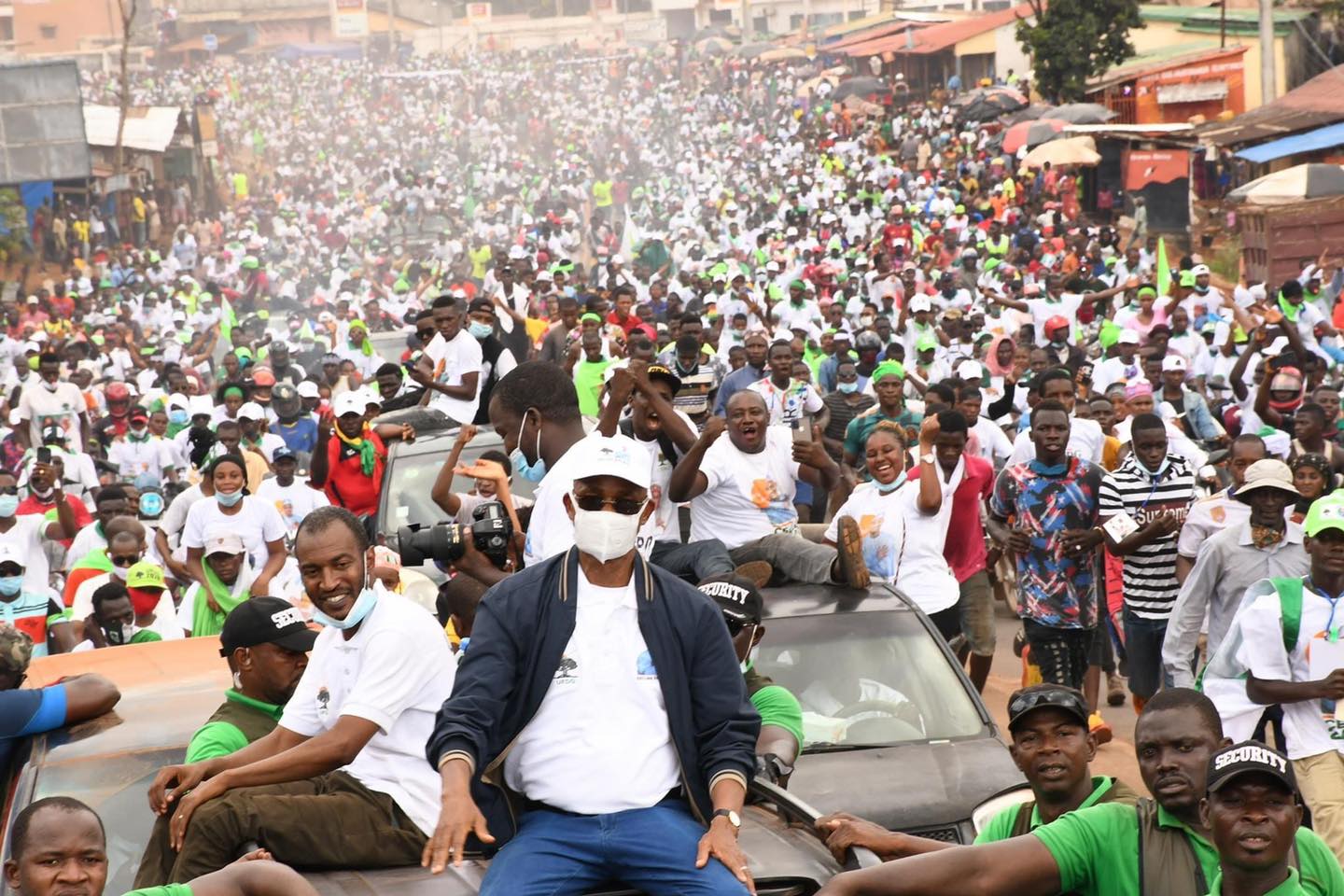
The crackdown is the latest in a sustained campaign against dissent under Doumbouya, who seized power in a 2021 coup before winning a presidential election in December — a vote from which all major opposition figures were barred from participating.
Since taking power, his government has shut down media outlets, banned protests and arrested or driven into exile scores of opposition figures and civil society activists. Guinea’s once-vibrant independent press has been reduced to a cautious whisper, and public demonstrations that were once common in Conakry now carry the very real risk of imprisonment.
Several relatives of prominent dissidents have also been abducted — a chilling tactic that extends the reach of repression beyond activists themselves, into families and communities. Two well-known pro-democracy activists have been missing since July 2024, their fates unknown and uninvestigated.
A widening coup belt across Africa
Guinea’s lurch toward authoritarianism does not exist in a vacuum. A wave of coups has brought military leaders to power across a belt of African nations stretching from the Atlantic Ocean through the Sahel region to the Red Sea since 2020. An attempted coup in Benin failed in late 2025, but the broader trend has only accelerated.
The phenomenon has led analysts to describe the pattern as a “coup belt” — a geographic and political arc where democratic governance has collapsed under the weight of military ambition, popular frustration, and post-colonial instability.
Madagascar and Guinea-Bissau saw their armies remove civilian leaders from power in late 2025, underscoring growing discontent with elected governments across the continent. The reasons are complex — corruption, economic mismanagement, ethnic tensions, and disillusionment with institutions that failed ordinary people — but the result in each case has been similar: soldiers in the presidential palace and opposition figures in exile or prison.
Although often initially carried out with popular backing — especially in nations where ousted leaders had grown deeply unpopular — these military takeovers have consistently seen civil liberties clawed back over time. The initial euphoria of a coup tends to curdle into something harder and more repressive.
A 2025 academic study found that while military takeovers have declined globally, the risk of coups in Africa remains comparatively high — a sobering assessment for international institutions that have struggled to respond effectively to each new wave of unconstitutional power grabs.
For Guinea’s citizens, the immediate reality is starker than any policy debate. With 40 parties dissolved in a single decree, the political landscape has been flattened. Whether the opposition — scattered across borders, stripped of resources and legal standing — can mount any meaningful challenge to Doumbouya’s consolidating grip remains deeply unclear.